


Sourcing motorcycles for international markets rarely comes down to a single purchase order. Buyers need consistent quality, fair pricing, and a manufacturing partner who understands the regulatory demands of the regions they serve. For fleet operators, dealers, and distributors comparing options, the factory behind the product often determines whether a shipment clears customs smoothly and holds up for years of real-world use.
China remains the dominant hub for two-wheeler production, and the reasons are structural rather than coincidental. Decades of manufacturing experience, mature supply chains, and a workforce skilled in both engineering and quality assurance have made the country the default sourcing destination for motorcycles sold across Europe, Africa, the Middle East, South America, and Southeast Asia. Still, not every factory operates at the same level. Buyers who skip proper due diligence on motorcycle manufacturers in china often end up paying for it later through warranty claims, shipping delays, or inconsistent build quality.
This article breaks down what separates a dependable manufacturing partner from the rest, what certifications and production scale buyers should expect, and how sourcing decisions shift depending on the motorcycle category being ordered.
What separates a trustworthy factory from the rest?
Plenty of suppliers advertise themselves as export-ready, but far fewer have the infrastructure to back that claim up. A genuine Chinese motorcycle factory typically runs from a large, purpose-built facility with multiple assembly lines, not a single cramped workshop with a few extra staff hired for busy seasons. Scale is the deciding factor here. It separates a supplier who can fulfill a container order on schedule from one who stumbles the moment order volume climbs.
Jiangmen Changhua Group Co., Ltd. offers a useful illustration of what this looks like in practice. Founded in 2000 and based in Guangdong Province, the company operates from a 45,000-square-meter facility with a 50,000-square-meter construction area. Nearly 400 staff work across its production lines, and half hold a college degree or higher. That blend of physical capacity and technical staffing supports annual production exceeding 100,000 units, with sales topping 500 million yuan per year.
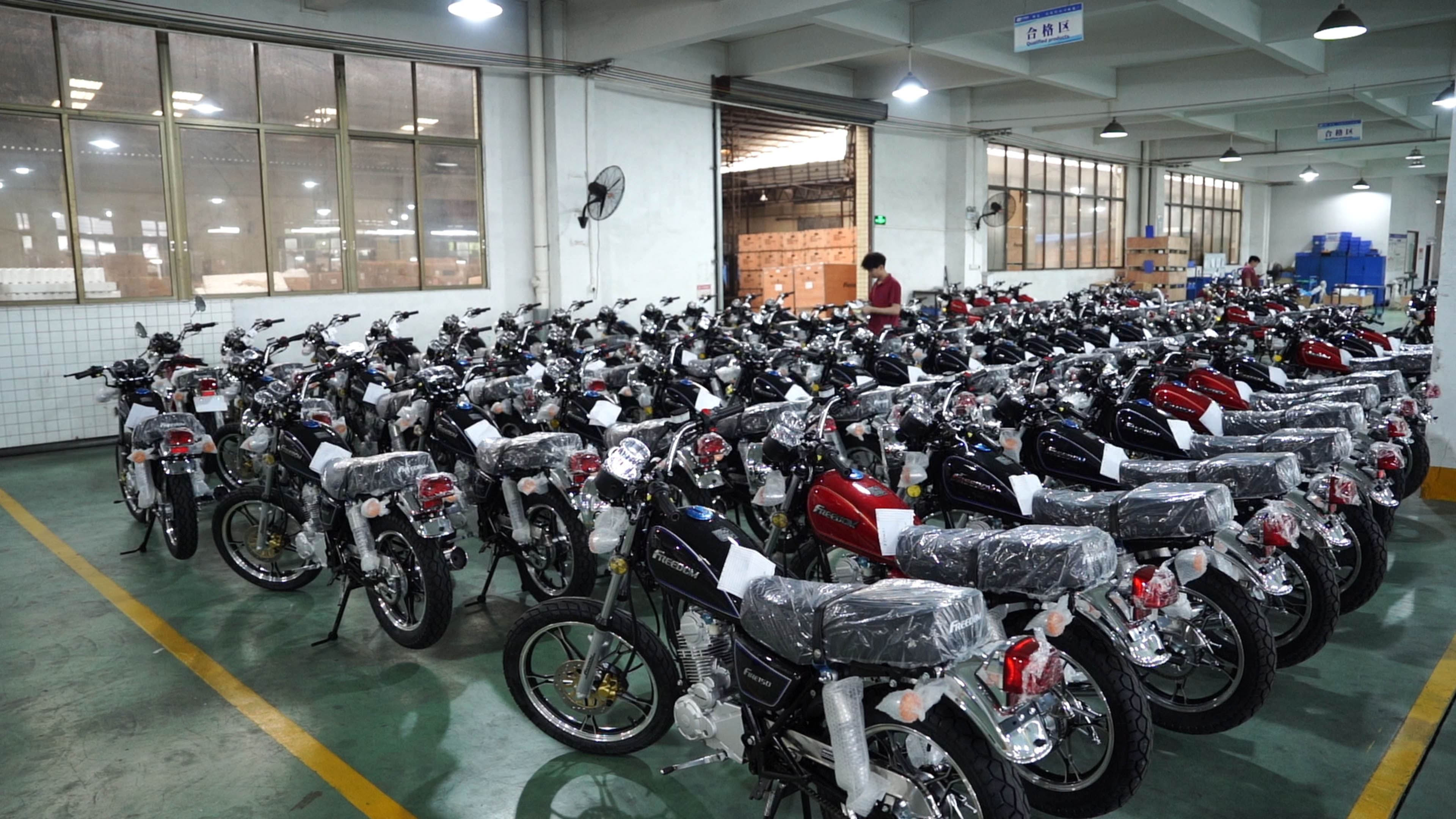
Certifications matter just as much as square footage. Buyers should confirm that a supplier holds ISO9001 quality management certification, "3C" certification, GCC certification for Gulf markets, and E-MARK certification for European compliance. These aren't bureaucratic checkboxes. They reflect whether a factory's production processes get audited and documented consistently, which directly affects how smoothly a shipment moves through customs once it reaches its destination country.
Why does production scale and R&D investment matter so much?
A factory's patent portfolio and engineering headcount often tell a more accurate story than its marketing brochures do. A manufacturer holding more than 30 patents and employing over 60 senior technical engineers signals real investment in product development, rather than simple assembly of parts bought from elsewhere. That kind of investment tends to surface in the small details: tighter manufacturing tolerances, better fuel efficiency, and fewer warranty claims once bikes reach customers.
This is also where buyers evaluating a wholesale price sport motorcycle producer need to look past the quoted unit cost. A low price means little if the factory lacks the engineering depth to maintain consistency across a 500-unit or 5,000-unit order. Competitive pricing and dependable quality aren't mutually exclusive, but they only coexist when a supplier has invested in the systems that make scale possible.
Which motorcycle type fits your market?
Different markets call for different product categories, and this is where sourcing decisions become more specific. A distributor serving rural transport needs in Africa faces entirely different requirements than a dealer targeting urban commuters in Southeast Asia or a retailer stocking recreational bikes for European riders.
Buyers targeting performance-focused customers often look for a wholesale price sport motorcycle producer capable of delivering competitive per-unit costs without cutting corners on engine reliability or braking systems. Sport models typically carry higher margins than standard commuter bikes, but they also demand tighter quality control since riders push these machines harder and expect more from every component.
Buyers focused on utility and daily transport, by contrast, tend to prioritize durability and low maintenance costs over raw speed. Off-road models, scooters, and tricycles each serve distinct use cases, from passenger transport to cargo hauling. A manufacturer offering a full product matrix gives buyers the flexibility to diversify their catalog without adding new supplier relationships to manage.
How do common export motorcycle categories compare?
Category | Typical Use Case | Key Buyer Priority |
|---|---|---|
Two-Wheeled Motorcycle | Daily commuting, general transport | Fuel efficiency, low maintenance |
Off-Road Motorcycle | Rugged terrain, rural access | Durability, ground clearance |
Sport Motorcycle | Performance riding, younger buyers | Power, styling, braking quality |
Scooter | Urban short-distance travel | Ease of use, storage space |
Electric Scooter | Eco-conscious urban riders | Battery range, charging time |
Tricycle | Cargo and passenger hauling | Load capacity, stability |
This kind of category breakdown helps buyers narrow down which product lines deserve priority based on actual demand patterns in their target market, rather than ordering a broad mix and hoping something sells.
What should you verify before signing a contract?
Once a buyer has shortlisted potential suppliers, a handful of practical checks can prevent costly mistakes later. Start by confirming that the certifications listed on a supplier's website match the documentation provided in the contract. Some companies list certifications they no longer hold active registration for. Next, ask about minimum order quantities and whether OEM or ODM customization is available, since branding requirements vary significantly from one market to another. Finally, request references from existing buyers in a similar region, since compliance requirements in the Middle East differ substantially from those in South America.
Buyers evaluating options among established motorcycle manufacturers in China should also look closely at export history. A company that has shipped consistently to multiple continents for over a decade has typically already worked through the logistical and regulatory hurdles that a newer exporter might still be navigating. That kind of experience translates into fewer surprises once a purchase order is placed.
Building a sourcing relationship built to last
Choosing a manufacturing partner isn't a one-time transaction. It's the foundation of a business relationship that can span years of repeat orders. Factories with established quality systems, deep product lines, and export experience across Europe, the Middle East, Africa, South America, and Southeast Asia tend to offer more stability than smaller operations still building their reputation.
For buyers ready to move forward, the next step is straightforward: request product catalogs, compare certifications side by side, and ask detailed questions about production capacity before committing to a purchase order. A manufacturer confident in its own quality standards will typically welcome that level of scrutiny rather than deflect it.
Frequently Asked Questions
What certifications should a motorcycle export supplier hold?
Look for ISO9001 quality management certification, "3C" certification for the Chinese domestic market, GCC certification for Gulf Cooperation Council countries, and E-MARK certification for European compliance. These confirm the manufacturer meets recognized safety and quality standards.
How does production scale affect delivery reliability?
Factories with multiple assembly lines and large facilities can typically absorb bulk orders without missing shipment deadlines, while smaller operations may struggle once order volume exceeds their standard capacity.
Can motorcycle manufacturers customize branding for overseas buyers?
Many established manufacturers offer OEM and ODM services, letting buyers apply their own branding, colors, and minor specification changes to standard product lines. Availability varies by supplier, so this should be confirmed before finalizing an order.
Which motorcycle category has the strongest export demand?
Demand varies by region. Rural and developing markets often favor durable, low-maintenance commuter and cargo models, while urban and recreational markets show stronger demand for scooters and sport motorcycles.


